

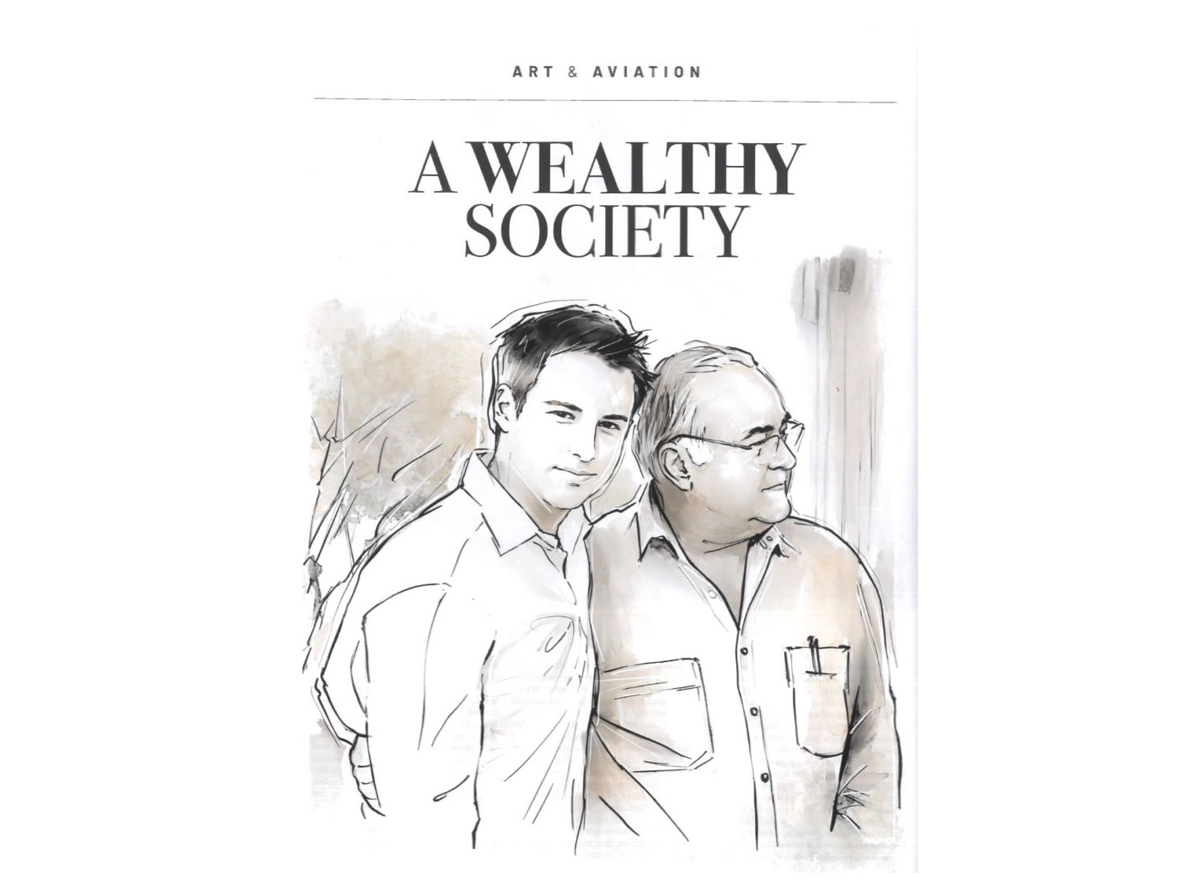
Why legacy isn’t what you leave behind. BY MARCOS AMARO
THERE COULD HARDLY be a more appropriate time to write about art, legacy and responsibility.
I’m writing from Tunisia, where I have been deeply struck by the way I have been welcomed. I have encountered generous and spontaneous people, moved above all by the desire to please God and to do good.
Yet perhaps this is precisely where one of the most beautiful contradictions of human existence lies: when we do something for another person without expecting any reward, we are already being rewarded through the good we are doing.
During this journey, I experienced situations I am unlikely ever to forget. Some people from whom I asked only for directions or assistance in arranging a taxi offered to drive me themselves, free of charge. Others even offered me money, concerned that I might need help.
These may appear to be simple gestures, but they are profoundly revealing. In a country that, in many respects, has limited material resources, I found people willing to offer everything they had. Some people possess a great deal and offer very little. Others possess very little and offer everything.
It is at this point that my Tunisian experience connects directly with the idea of legacy: a society’s true wealth lies not only in its institutions or financial reserves.
Legacy is not merely what we build, acquire or preserve. Legacy is, above all, what we leave within other people. It may be found in a work of art, a museum, a historic aircraft, an institution or a social project. But it may also be found in a gesture of openness, a word spoken at the right moment, an opportunity offered or a mistake that we had the courage to acknowledge and correct.
I confess that I feel somewhat embarrassed writing about my own accomplishments. Nevertheless, much of what I do, whether through art or aviation, is born from the desire to give back to the world a little of everything I once received.
Over time, I came to understand that personal achievements find their deepest meaning only when they are transformed into collective benefit. It is this conviction that guides the projects to which I now dedicate myself in Brazil.
I have the responsibility of leading both an aviation museum and an art museum.
The aviation museum preserves historic aircraft that embody the courage of men and women who dreamed of flying and challenged limits. The art museum, with a collection predominantly dedicated to Brazilian art, preserves identities, concerns, dreams, conflicts and emotions, revealing not only what we once were, but also who we are and what we may yet become.
Yet the deepest purpose of both projects lies in their social and human dimensions. A museum should not be merely a place where important objects are stored. It should be a living space for education, belonging, inspiration, and transformation.
A historic aircraft may awaken in a child the desire to study engineering or aviation. A painting may offer a young person a new way of understanding their own history. A visit may broaden horizons or restore someone’s ability to dream.
Preserving the past only makes sense when that preservation helps to build the future. Art should not exist merely to decorate walls. Aviation should not be remembered only for its machines. Heritage should not be protected solely because of its economic value or rarity. All of these should serve people.
Tunisians have reminded me that a legacy may begin with a monumental work, but also with a simple ride offered to a stranger. It may arise from the creation of a museum, but also from the gesture of offering money to someone in need.
As I reflect on these experiences, I also think of Monaco, a place where the question of legacy carries particular significance. Beyond its recognized prosperity, the Principality has long cultivated a tradition of philanthropy, cultural patronage and international responsibility, demonstrating that success finds its highest purpose when it contributes to the common good.
In the end, perhaps we will not be remembered only for what we accumulated, created or preserved. We will be remembered, above all, for the way we made others feel, for the opportunities we created, and for the good we chose to do while there was still time.
And the time to do good is always now.
Marcos Amaro is the founder of Museu FAMA and Amaro Aviation, and serves as president of Museu Asas de um Sonho and AMAPA (Association of Friends of the São Paulo Aerospace Museum).
